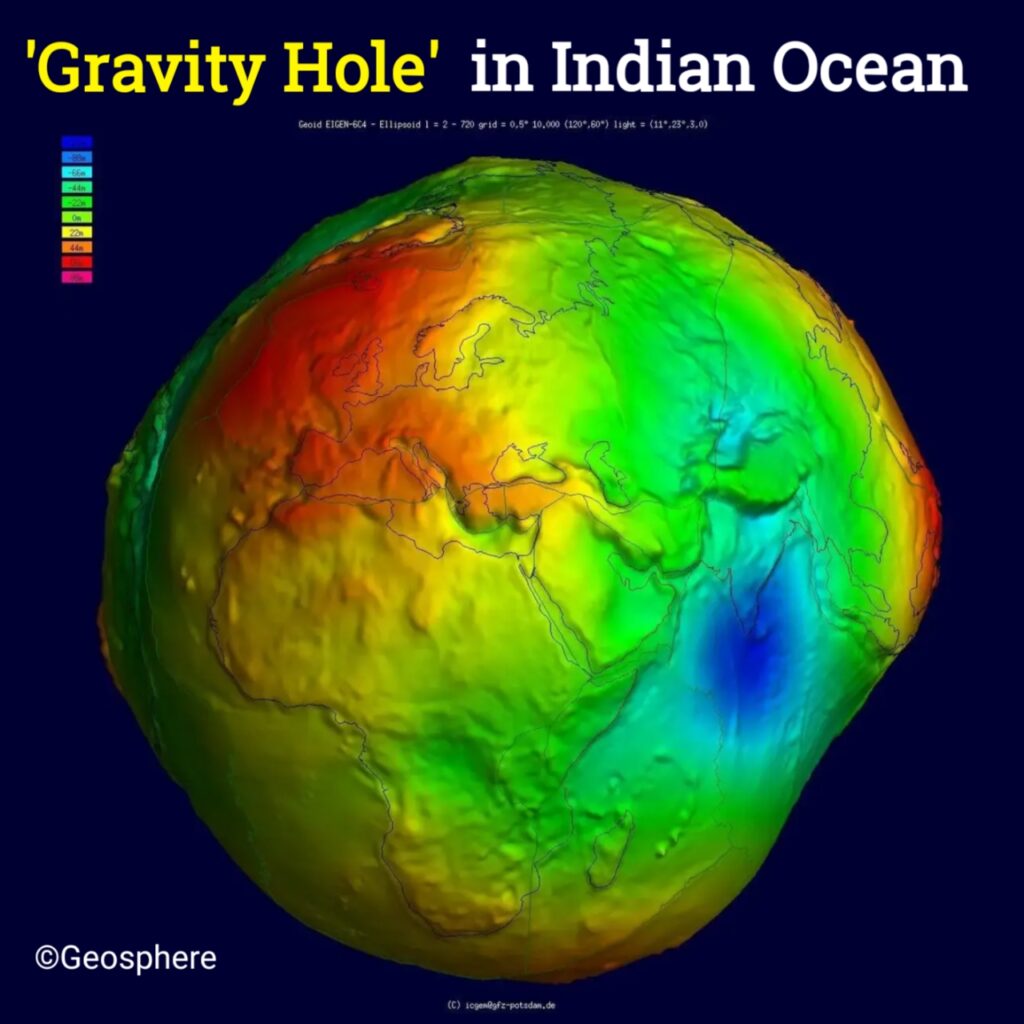
The origin of the Earth’s lowest geoid, the Indian Ocean geoid low (IOGL) has been controversial. The geoid predicted from present-day tomography models has shown that mid to upper mantle hot anomalies are integral in generating the IOGL. Here we assimilate plate reconstruction in global mantle convection models starting from 140 Ma and show that sinking Tethyan slabs perturbed the African Large Low Shear Velocity province and generated plumes beneath the Indian Ocean, which led to the formation of this negative geoid anomaly. We also show that this low can be reproduced by surrounding mantle density anomalies, without having them present directly beneath the geoid low. We tune the density and viscosity of thermochemical piles at core-mantle boundary, Clapeyron slope and density jump at 660 km discontinuity, and the strength of slabs, to control the rise of plumes, which in turn determine the shape and amplitude of the geoid low.
Read full research article: https://doi.org/10.1029/2022GL102694